
Some Important Results
If ‘k’ is a positive real number, then |x| k k x k, x -k, k.
If ‘k’ is a positive real number, then |x| k k x k, x -k, k.
If ‘k’ is a positive real number, then |x| k x -k, x k.
If ‘k’ is a positive real number, then |x| k x -k, x k.
If ‘k’ is a positive real number and ‘y’ is a fixed number, then
|x - y| k y k x y + k, x y -k, y + k.
If ‘k’ is a positive real number and ‘y’ is a fixed number, then
|x - y| k y k x y + k, x [y -k, y + k].
If ‘k’ is a positive real number and ‘y’ is a fixed number, then
|x - y| k x y – k or x y + k
If ‘k’ be a positive real number and ‘y’ is a fixed number, then
|x - y| k x y – k or x y + k
If a, b and c are positive real numbers, then a |x| b x (-b, a) (a, b)
If a, b and c are positive real numbers, then a |x| b x [-b, a] (a, b)
If a, b and c are positive real numbers, then a |x - c| b x [-b + c, -a + c][a + c, b + c]
If a, b and c are positive real numbers, then a |x - c| b x (-b + c, -a + c)(a + c, b + c)
Definitions
Two real numbers or two algebraic expressions related by the symbol ‘<’, ‘>’, ‘≤’ or ‘≥’ form an inequality.
Inequalities containing ‘<’, or ‘>’ are called strict inequalities.
Inequalities containing ‘≤’ or ‘≥’ are called slack inequalities.
An inequality containing any two of ‘<’, ‘>’, ‘≤’ or ‘≥’ is called double inequality.
Solution an inequality in one variable is the value of the variable which makes it a true statement.
Solving an inequality is the process of getting all possible solutions of an inequality.
Solution set is the set of all possible solutions of an inequality is known as its solution set.
A linear expression in one variable involving the inequality symbol is linear inequality in one variable.
General forms
ax + b < 0
ax + b > 0
ax + b ≤ 0
ax + b ≥ 0
A linear inequality involving two variables is known as a linear inequality in two variables. General forms
ax + by < c
ax + by > c
ax + by ≤ c
ax + by ≥ c
The following is the example of quadratic inequalities known as quadratic inequalities
ax² + bx + c ≤ 0
ax² + bx + c ≥ 0
The inequalities of the form ‘<’ or ‘>’ are known as strict inequalities, whereas if they are of the form ≤ or ≥ then they are called slack inequalities.
The region containing all the solutions of an inequality is called the solution region.
The solution region of the system of inequalities is the region which satisfies all the given inequalities in the system simultaneously.
Quadratic inequality is the quadratic polynomial with an inequality sign. Generic quadratic inequality is of the form ax2 + bx + c > 0.
Concepts
If two real numbers are related by the symbols ‘<’, ‘>’, ‘≤’ or ‘≥’, then the inequality is a numerical inequality and in case of algebraic expressions it is literal inequality.
2<3 is numerical inequality.
5x + 2 ≤ 7 is literal inequality.
Rules for simplifying the inequalities
Rule 1: Equal numbers may be added to (or subtracted from) both sides of an equation.
If a < b, then a + c < b + c.
Rule 2: Both sides of an equation may be multiplied (or divided) by the same non-zero number.
If a < b, then ac < bc
Rule 3: Sign of inequality is reversed in case of multiplication (or division) by a negative number.
If a < b, then ak > bk, where k is a negative number.
Rule 4: Sign of inequality is reversed in case of taking the reciprocals.
A linear inequality can be solved by the following steps:
Obtain the linear inequality.
Group all variable terms on one side of the inequality and transpose the constant term on the other side of the inequality.
Simplify both the sides of the inequality to the standard form
ax b, or ax b, or ax > b, or ax b
Solve the inequality by dividing both the sides of the inequality by the coefficient of the variable.
Write and depict the solution set in the form of number line.
Some examples of graphs of linear inequality: A linear inequality in one variable can be represented graphically as follows:Representation of x 1

 Representation
of
x
1
Representation
of
x
1

 Representation
of
x
> 1
Representation
of
x
> 1

 Steps
to solve inequalities of the type,
Steps
to solve inequalities of the type,
- Step 1: Transpose all the variable terms on LHS.
- Step 2: Transpose all the variable terms on LHS.
- Step 3: Simplify the terms in LHS.
- Step 4: Make the coefficient of x positive in the numerator and denominator.
- Step 5: Equate both the numerator and denominator to zero and find the values of x and critical points.
- Step 6: Plot these critical points on the number line, which will divide the real line into three regions.
- Step 7: Mark the sign of the functions over the respective intervals.
- Step 8: Write solution regions in the form of intervals to get the required solution sets of the given inequality.
A linear inequality in two variables represents a half plane geometrically. Types of half planes.


In order to identify the half plane represented by an inequality, take any point (a, b) (not on line) and check whether it satisfies the inequality or not. If it satisfies the inequality, then the inequality represents the half plane and subsequently shades the region which contains the point; otherwise, the inequality represents the half plane which does not contain the point within it. For convenience, the point (0, 0) is preferred.
If an inequality is of the type ax + b ≥ c or ax + b c, i.e slack inequality, then the points on the line ax+ b = c are also included in the solution region.

 Solution
of
slack
inequality
Solution
of
slack
inequality
If an inequality is of the form ax + by > c or ax + by < c, then the points on the line ax + by = c are not to be included in the solution region.

 Solution
of
strict
inequality
Solution
of
strict
inequality
To represent x < a (or x > a) on a number line, put a circle on the number a and dark line to the left (or right) of the number a.
To represent x ≤ a (or x ≥ a) on a number line, put a dark circle on the number a and dark line to the left (or right) of the number x.
Steps to represent the linear inequality in two variables graphically
Step 1: Rewrite the inequality as linear equation, i.e. ax + by = c.
Step 2: Put x = 0 to get y-intercept of the line, i.e. (0, c/b).
Step 3: Put y = 0 to get x-intercept of the line, i.e. (c/a, 0).
Step 4: Join the two points, each on X-axis and Y-axis to get the graphical representation of the line.
Step5: Choose a point (x1, y1) in one of the planes, i.e. either to the left or right or upper or lower half of the line, but not on the line.
Step 6: If (x1, y1) satisfies the given inequality, then the required region is that particular half plane in which (x1, y1) lie.
On the other hand, if (x1, y1) does not satisfy the given inequality, then the required solution region is the half plane which does not contain (x1, y1).
Linear inequalities represent regions; regions common to the given inequalities will be the solution region.
Similar to linear equations, there can be cases of overlapping of regions or no common regions for the given inequalities.
To solve a system of inequalities graphically
Change the sign of equality to inequality and draw the graph of each line.
Shade the region for each inequality.
Common region to all the inequalities is the solution.
A linear inequality divides the plane into two half planes, while a quadratic inequality is represented by a parabola which divides the plane into different regions.
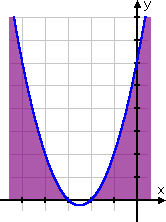
Region represented by the inequality x2 + 5x + 6 > 0

Interval Notations
Open Interval: The interval which contains all the elements between a and b excluding a and b. In set notations:
(a, b) = {x : a < x < b}

Closed interval: The interval which contains all the elements between a and b and also the end points a and b is called the closed interval.
[a, b] = {x : a x b}

Semi open intervals:
(a, b) = {x : a x < b} includes all the elements from a to b including a and excluding b.
[a, b] = {x : a < x b} includes all the elements from a to b excluding a and including b.
INTERVALS
1
A subset of number line is called an interval if it contains all the real numbers lying between every pair of its elements.
Let , then the set
(i) is called a closed interval and is denoted by [a, b].
(ii) is called an open interval and is denoted by (a, b), or ]a, b[.
(iii) is called left closed and right open interval and is denoted by [a, b) or [a, b[.
(iv) is called left open and right closed interval and is denoted by (a, b] or ]a, b].
(v) Discrete number are represented by curly { } brackets, e.g. {a, b}.
1.1 Number line

The extension of number line is from –¥ to +¥ and any real number can be represented on this number line.
The solution of the inequations are shown on this number line as illustrated in the following examples
Question: Solve x < 7 for the following cases
(a) x Î I (b) x Î N (c) x Î R
Solution: (a)
In this
case

The infinite solutions are represented by dots
(b) x < 7,
In this
case

The finite solutions are represented by dots.
(c) x < 7,
 The
infinite solutions are represented by a dark line as shown. A circle
over 7 indicates that point 7 is not included in the solution.
The
infinite solutions are represented by a dark line as shown. A circle
over 7 indicates that point 7 is not included in the solution.